About This Book
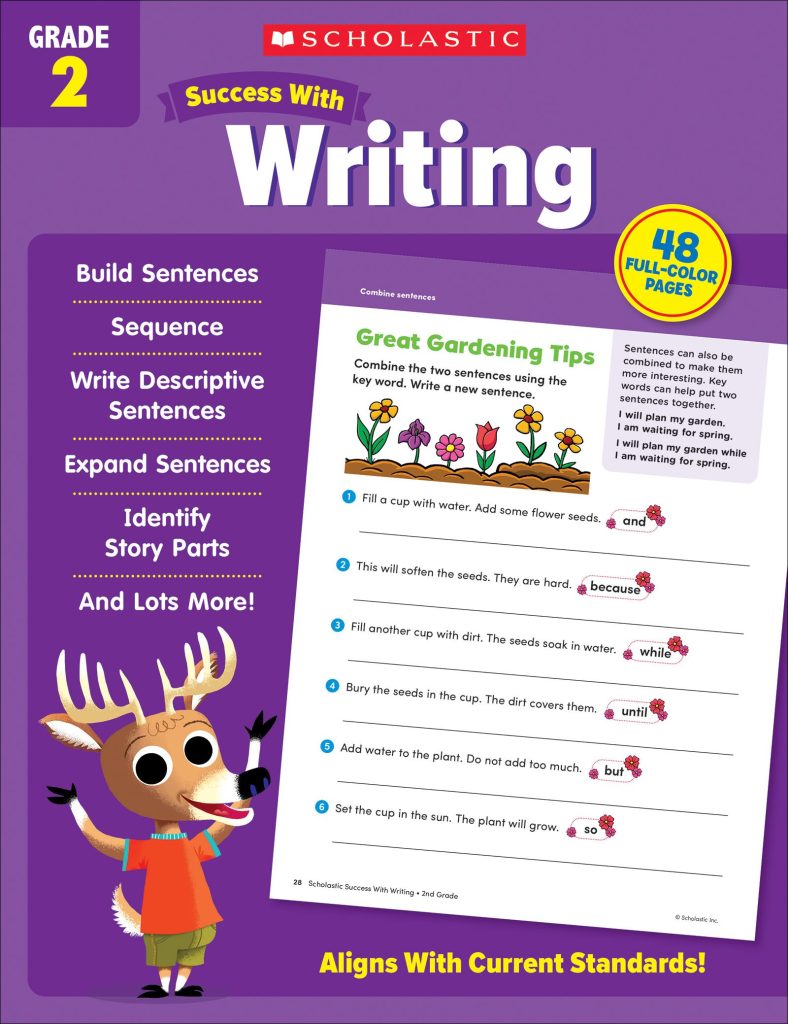
Scholastic Success With Writing Workbook 2 is the writing workbook of Scholastic’s Success With series at its second level — the stage where the unit of writing grows from the sentence to the sequence. It is a practice book in the strict sense: pages of structured exercises that teach sentences to connect, describe, and conclude, in that order of difficulty.
Ask what changes between a child who can write sentences and a child who can write, and the answer is transitions. The second sentence is a new invention: it must know about the first — continue it, add to it, sometimes contradict it gracefully — and the child must hold both in mind at once. That double-holding is the germ of all composition. Second-level instruction builds it deliberately: joining words that weld sentences together, ordering words that lay time out flat (first, next, finally), and describing words that thicken the picture a sequence paints. Underneath runs a second, quieter curriculum — stamina. A page of connected writing costs more than a page of single sentences, and the workbook’s job is to make the cost feel like achievement rather than labour. The Success With format carries its share of that job: the same trusted page shapes, the same completable steps, now filled with longer journeys — so the learner notices the distance travelled, not the effort of travelling.
What Learners Will Practise
Sentences in Sequence
Learners practise the connective tissue of writing: joining words and time words that turn isolated sentences into a recount with a pulse. The exercises make sequence physical — events laid in order, each new sentence aware of the one before it.
Describing Words
The workbook practises the adjective as an act of attention: choosing the word that makes the reader see the specific dog, not any dog. Description is taught as generosity — detail given so a stranger’s mind can build the same picture the writer’s holds.
Beginnings, Middles, Ends
Second-level practice introduces the story’s skeleton in its simplest true form: something starts, something happens, something settles. Supplying a missing ending to a given tale is the gentlest possible first lesson in structure — the architecture learned from inside a finished house.
Key Features
The growth of the unit is the feature: writing practised at the scale of connected text while the steps stay workbook-small. The connective curriculum is the second — joining and ordering words taught as tools, not terminology — and the series format the third, the same Success With architecture as the level below. In this collection it is the writing shelf’s second step, where composition begins.
Who This Book Is For
Writers who have sentences and want stories are its first audience. Teachers form its second readership, sequencing the leap from items to texts. Parents make its third: second-level writing produces the first documents worth keeping in a drawer — the birthday recount, the trip report — evidence that a mind has learned to travel on paper.
How to Use This Book
Read the sequences aloud with ceremony: connected writing is music with a beat, and the child should hear their own sentences keeping time. When joining practice gets mechanical, supply real material — yesterday’s actual events, in order — because the connective words learn fastest on true stories the writer urgently wants to tell.
Related Books
The writing shelf’s first step stands at Scholastic Success With Writing Workbook 1, and its coming-of-age volume waits at Scholastic Success With Writing Workbook 3.