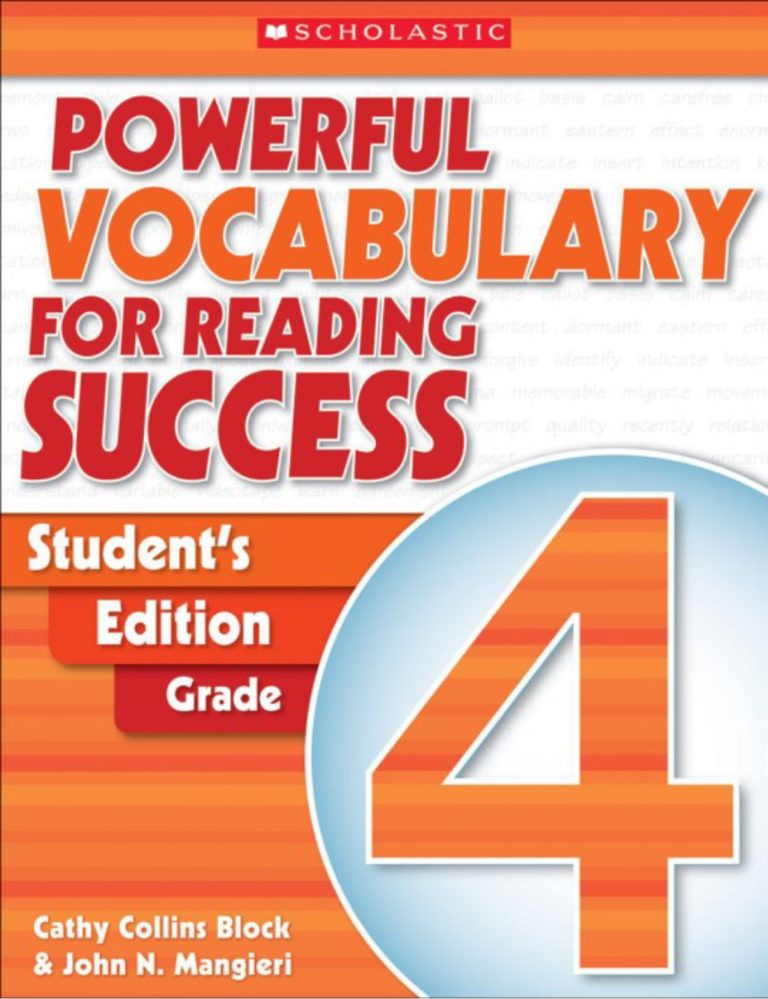
About This Book
Powerful Vocabulary for Reading Success is a programme built on the strongest finding in reading science — vocabulary is comprehension’s engine — and Student’s Book 4 is its fourth-year engine room: the level where school reading turns academic and the words must be taught, not awaited.
What Students Will Learn
Words in Families
The morphological core: roots, prefixes and suffixes taught as machinery, so each new word arrives with its relatives — the strategy that multiplies a vocabulary faster than any list, and transfers to every subject’s terminology.
The Academic Word Stock
The vocabulary of the textbooks themselves: the verbs of explaining and arguing, the nouns of processes and quantities, the connectives that signal contrast, cause and sequence — the words whose absence makes content subjects feel harder than they are.
Strategies for Unknown Words
Meeting a strange word mid-passage is a reading event, not a failure: context clues, word parts, and the dictionary used surgically — the strategies practised here until the reader deploys them unbidden in every book.
Key Features
System is the feature: a sequenced, revisited, cumulative vocabulary curriculum where schools usually have none. The morphology is the second — words taught as structures, not memoranda — and the reading integration the third: every word is learned inside the act it serves.
Who This Book Is For
It is for upper-elementary students (the programme’s fourth level), reading and language-arts teachers, literacy coordinators building a vocabulary strand, tutors repairing comprehension, and homeschooling families following the programme in sequence.
How to Use This Book
Teach the units in order — the word families are sequenced to compound. Insist on the words aloud and in writing: a word the student has said and used in their own sentence is halfway owned. Revisit through the programme’s reviews rather than re-teaching, and connect the week’s words to the science and social-studies texts the class is already reading; transfer is the point of the whole design.
Related Books
The next level is Powerful Vocabulary Student’s Book 5. The final level is Powerful Vocabulary Student’s Book 6.